
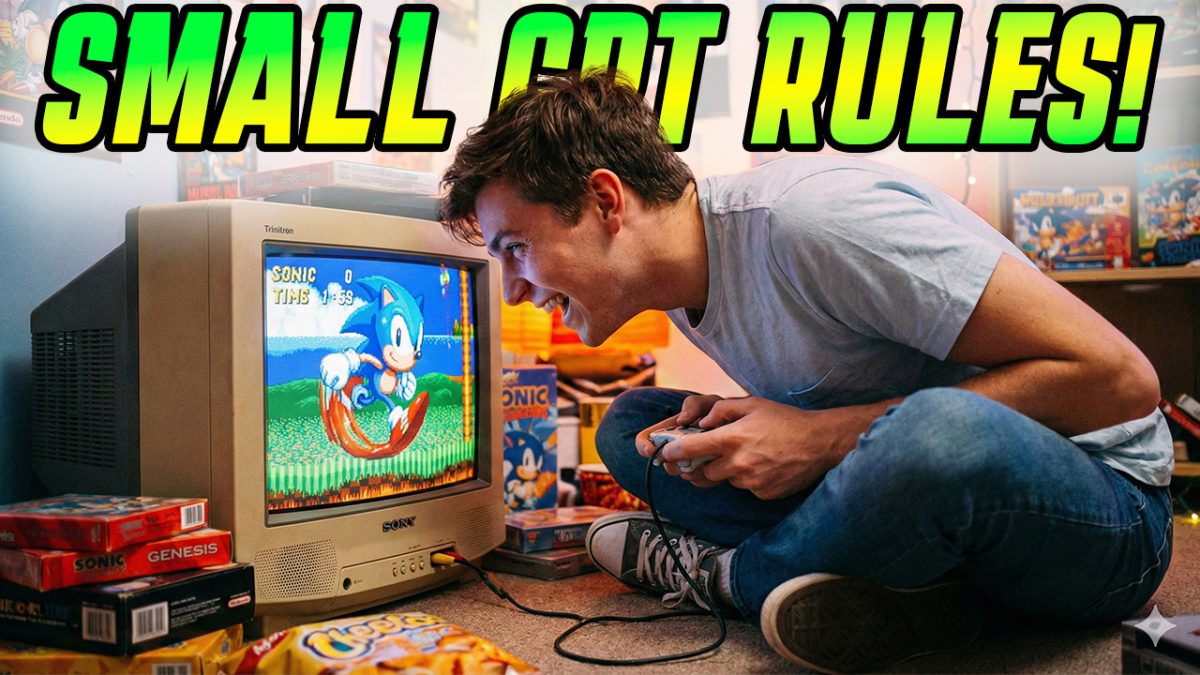
Everyone online keeps chasing the biggest, sharpest, most “professional” CRT they can find. PVMs. BVMs. Studio monitors. Huge screens with insane line counts. But after actually playing on different setups for a long time, I realized something that nobody really says out loud:
Small CRTs are way more fun for retro gaming.
Not technically “better” on paper.
Not more expensive.
Not more impressive on Instagram.
But for actually sitting down and playing NES, SNES, Sega Master System or PS1 — smaller CRT TVs often feel right in a way big ones just don’t.

Big CRTs Look Cool — But They Can Feel Wrong
Don’t get me wrong. A massive CRT looks insane. A big Sony Trinitron or a PVM on a desk feels like pro-level gaming gear. But here’s the thing nobody mentions:
The bigger the CRT, the more you notice its flaws.
On large screens, you start seeing:
- Blurry scaling
- Geometry warping
- Convergence issues
- Uneven brightness
- Corners that don’t line up perfectly
On a smaller TV, those same issues basically disappear. The image looks tighter. Sharper. More “locked in.” You spend less time adjusting service menu settings and more time actually playing.
Smaller CRT = Sharper Pixels (Even If the TV Isn’t “Better”)
This part surprises a lot of people.
A small consumer CRT can feel sharper than a pro monitor
even when the pro monitor has higher resolution.
Why?
Because retro consoles output low resolution. NES, SNES and Sega Master System were never designed for 20-inch+ precision displays. When you stretch 240p across a large CRT, the image softens. On a smaller screen, pixels naturally look cleaner and more defined — without any filters or fake sharpening.
It just works.
Scanlines Look Better on Small Screens
Scanlines on a big CRT look cinematic.
Scanlines on a small CRT look nostalgic.
On smaller screens, scanlines blend perfectly into sprites. They don’t distract you. They don’t stand out. They just “exist” the way they did when these games were new.
If you ever feel like shaders can’t fully recreate CRT magic — this is a big reason why. Screen size matters just as much as phosphor and beam spot size.
You Play Differently on a Small CRT
This part is weird but true.
On a smaller TV:
- You sit closer
- You focus more
- Your eyes stay centered
- You react faster
Games feel harder in a good way. More personal. More intense. Golden Axe Warrior on a small CRT feels more dangerous than on a huge display. Zelda feels more mysterious. NES platformers feel tighter and faster.
It’s closer to how these games were originally played.
Smaller CRTs Are Easier to Live With
Let’s be honest for a second:
Huge CRTs are heavy.
Awkward to move.
Hard to repair.
Hard to find.
Small CRTs:
- Fit on desks
- Cost less
- Are easier to replace
- Need less space
- Are easier to rotate and tweak
You spend less time “maintaining a museum piece” and more time playing games.
So… Are PVMs and BVMs Overrated?
No.
But they’re also not magic.
They’re tools. Not guaranteed upgrades.
If you’re chasing perfection instead of enjoyment, you might actually hurt your experience. For some people, a simple 14″ Trinitron delivers more happiness than a perfectly calibrated broadcast monitor.
That’s not tech failure.
That’s taste.
The Truth Nobody Wants to Admit
There is no “best” CRT.
There is only the CRT that makes you want to play one more level.
If a small consumer TV does that?
Then it’s better — regardless of what the specs say.
Final Thought
If you’re new to retro gaming and everyone is telling you that you need a professional monitor before you even start…
Ignore that.
Start small.
Play more.
Upgrade only if you really feel the need.
Retro gaming isn’t about owning the “right” screen.
It’s about enjoying the game on your screen.