
Today, video games use realistic lighting, surround sound, detailed animation and enormous worlds to create immersion. In the early 1980s, developers had only a tiny fraction of that technology. Yet some games still managed to pull players completely into their worlds.
For me, Aztec Challenge on the Commodore 64 was one of those games.
Its graphics were simple, its controls were unforgiving and its characters were made from only a handful of pixels. None of that stopped it from feeling dangerous, dramatic and surprisingly cinematic. When I played it, I was not thinking about technical limitations. I was focused on surviving the next spear.

A Simple Idea That Created Constant Tension
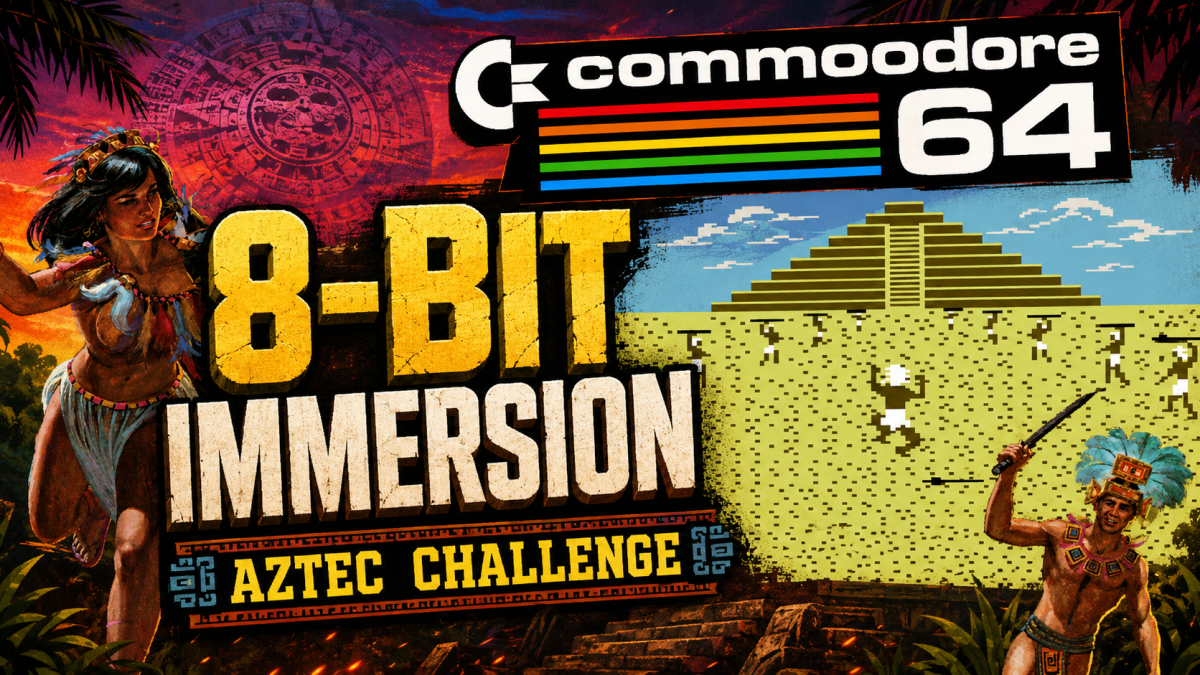
The opening stage is immediately memorable. Your character runs toward a distant pyramid while warriors on both sides throw spears across the screen.
Mechanically, it is simple. You move, duck and jump at the correct moment. But the presentation transforms this basic challenge into something much more intense.
The pyramid remains in the distance, giving you a clear destination. The enemies surround the player from both sides, creating the feeling of running through hostile territory. Spears travel across the screen at different heights, forcing you to react quickly and constantly watch the environment.
The limited visuals actually make everything easier to read. There are no complicated particle effects or unnecessary background details. The pyramid, the attackers, the player and the incoming weapons are all immediately visible.
That clarity allows the tension to come from the gameplay itself.
Music Was a Major Part of the Experience
The music is one of the most important reasons Aztec Challenge felt so immersive.
The Commodore 64’s SID sound chip could not reproduce realistic instruments, but realism was not necessary. The soundtrack created urgency and gave the action a strong identity. Its rhythm made the player feel as though something dangerous was constantly approaching.
That music stayed in my memory long after I stopped playing the game.
This is one of the strengths of many classic Commodore 64 games. Their soundtracks were not simply background decoration. Music often carried the atmosphere that the graphics could only suggest.
In Aztec Challenge, the combination of music, movement and repeated spear attacks created a surprisingly powerful sense of pressure.
Your Imagination Completed the Picture
The game’s cover art presented a dramatic world filled with warriors, pyramids and danger. The actual gameplay looked much simpler, but that difference did not necessarily weaken the experience.
As a child, the artwork, title, music and graphics all became part of the same world. The detailed illustration gave context to the basic shapes appearing on the screen. The player’s imagination connected everything together.
A small pixel character was not just a simple sprite. It represented someone running through a deadly Aztec gauntlet.
That is an important part of early gaming that can be difficult to reproduce today. Modern games show almost everything directly. Older games often provided only the essential pieces and allowed the player’s imagination to create the rest.
Immersion Is Not the Same as Realism
Aztec Challenge is a good example of why immersion should not be confused with graphical realism.
A game can have realistic textures and advanced lighting while still failing to hold the player’s attention. Another game can use only a few colours, simple sprites and basic animation yet create a strong emotional reaction.
Immersion comes from the way all the elements work together:
The player understands the goal. The danger is clearly communicated. The music supports the action. The controls demand concentration. Every part of the game pushes the player toward the same experience.
That is exactly what Aztec Challenge achieved.
Its technology was limited, but its design was focused.
A Game That Still Represents the Commodore 64 Era
Returning to Aztec Challenge today is obviously different from playing it during the early Commodore 64 era. The surprise is gone, the graphics are familiar and modern players have experienced games that are infinitely more complex.
However, its atmosphere still works.
The opening stage remains instantly recognizable. The music still creates tension. The large character movement and incoming spears still make the action feel physical and immediate.
It is also a reminder that older games should not always be judged by modern standards. Their value does not come from competing with current technology. It comes from understanding what developers achieved with the tools available at the time.
Revisiting a Personal Gaming Memory
In my video, I return to Aztec Challenge, share my nostalgic memories and examine why it felt so special to me.
This is not simply a look at an old Commodore 64 game. It is a look back at a period when a handful of pixels, a memorable soundtrack and a strong concept could create an entire world inside the player’s imagination.
Aztec Challenge may look primitive today, but in 1983, it felt like 8-bit immersive play.